What Is the Rule of Thumb for Condo Insurance? A Claims-Based Guide
By: Shoreline Public Adjusters
Updated: March 2026 · 9 min read
In This Post:
- Why Generic Condo Insurance Rules of Thumb Fail
- The Only Condo Insurance Rule That Matters: Know Your Master Policy
- How to Calculate HO6 Dwelling Coverage (Coverage A)
- How Much Personal Property Coverage Do Condo Owners Need
- Loss Assessment Coverage: The Most Undervalued Line on Your HO6
- Real Outcome: Fort Myers Condo Owner After Hurricane Ian
- Common Mistakes Condo Owners Make When Setting Coverage Limits
- Frequently Asked Questions About Condo Insurance Coverage
A condo owner in Fort Myers carried $20,000 in dwelling coverage on her HO6 policy — the amount her insurer suggested when she bought the unit. After Hurricane Ian pushed water through the sliding doors and stripped the exterior wall finish, her interior rebuild cost $94,000. The insurer paid $17,200 after the deductible and depreciation. The remaining $76,800 was her responsibility.
She didn't realize her association's master policy was bare walls-in. She didn't realize $20,000 in Coverage A wouldn't cover the flooring alone. And every "rule of thumb" article she'd read before the storm told her to insure for 20% of her unit's purchase price — which is how she ended up at $20,000 on a $100,000 unit.
Why Generic Condo Insurance Rules of Thumb Are Dangerous
I spent over a decade in enterprise risk management, advising organizations on how to structure coverage programs that eliminate gaps before a loss event exposes them. The condo insurance "rules of thumb" that dominate page one of Google — 20% of market value, $40–$60 per square foot, the 80% rule — exist to simplify a decision that cannot be simplified.
Every one of those formulas ignores the variable that determines whether your coverage is adequate: your association's master policy type. Without knowing whether your building carries bare walls-in, single entity, or all-in coverage, no percentage or per-square-foot formula can tell you what your HO6 dwelling limit should be.
The Only Condo Insurance Rule That Matters: Know Your Master Policy
The rule of thumb for condo insurance is this: your HO6 policy must cover everything your association's master policy doesn't. Every dollar of coverage you need depends on where the master policy stops and your responsibility starts.
There are three master policy types, and each one changes your HO6 requirements entirely.
Bare walls-in (most common in Florida). The master policy covers the building structure — exterior walls, roof, common areas — and nothing inside your unit. Your HO6 Coverage A must rebuild your entire interior: drywall finish, flooring, cabinets, countertops, fixtures, appliances, plumbing fixtures, and any upgrades you've made. This is the most expensive coverage responsibility and the one most owners underinsure by $50,000–$100,000.
Single entity. The master policy covers the building structure plus the original interior finishes as constructed. Your HO6 Coverage A only needs to cover improvements and upgrades beyond the original builder-grade finishes. If you've renovated a kitchen or upgraded bathrooms, that differential is your exposure.
All-in (least common). The master policy covers the building, original finishes, and unit owner improvements. Your HO6 Coverage A exposure is lowest here, but you still need personal property, liability, loss of use, and loss assessment coverage.
⚠️ What Insurers Won't Tell You: Most condo insurers sell HO6 policies with default dwelling limits of $15,000–$25,000 regardless of master policy type. Under bare walls-in, that default can leave you $60,000–$100,000 short on a single claim. The insurer's default protects their premium calculation, not your financial exposure.
How to Calculate HO6 Dwelling Coverage (Coverage A)
The generic "20% of condo value" rule fails because market value and rebuild cost are different numbers. A $300,000 condo in a 1990s building may cost $120,000 to rebuild the interior because labor and materials have inflated since construction. A $150,000 condo with granite countertops and hardwood floors may cost more to rebuild than the unit is worth.
Here's how to calculate your actual Coverage A need based on your master policy type.
Bare walls-in formula:
- Get the square footage of your unit interior.
- Multiply by the local interior rebuild cost per square foot. In Florida, this ranges from $65–$120/sq ft depending on finish quality and county. In Minnesota, it's $70–$110/sq ft. In Wisconsin, it's $65–$100/sq ft.
- Add the replacement cost of any upgrades above builder grade — granite, hardwood flooring, custom cabinetry, high-end fixtures.
That total is your Coverage A minimum.
Example: 1,200 sq. ft. unit in Naples, FL with mid-grade finishes: 1,200 × $85/sq ft = $102,000 base + $15,000 in kitchen upgrades = $117,000 Coverage A minimum.
The insurer's default of $20,000 would have left $97,000 uncovered.
Single entity formula: Get a contractor estimate for the cost to restore your unit to its current condition, minus the cost of builder-grade original finishes. The differential is your Coverage A target.
All-in formula: Your Coverage A exposure is minimal — but confirm by requesting the association's certificate of insurance and verifying the master policy actually covers improvements. Some policies marketed as "all-in" exclude unit owner upgrades installed after a certain date.
📋 Florida Law: Under Fla. Stat. § 718.111(11), your condo association must provide a certificate of insurance to any unit owner who requests it, within 30 days. This is the only way to confirm your master policy type. If you don't have it, request it before setting your HO6 limits. Source: Florida Legislature
How Much Personal Property Coverage Do Condo Owners Need
Personal property coverage (Coverage B) is the second line most condo owners get wrong. The master policy never covers your belongings — not under any policy type.
The standard advice is to estimate 50–70% of your dwelling coverage for personal property. That formula is backward — your belongings don't scale with your interior rebuild cost. A unit owner with $30,000 in furniture and electronics needs $30,000 in Coverage B whether the dwelling limit is $15,000 or $150,000.
The replacement cost inventory method:
Walk through every room. Estimate what it would cost to replace every item at today's retail prices — not what you paid, not what it's "worth" on a used market. Include furniture, electronics, clothing, kitchen items, artwork, sports equipment, tools, and anything stored in your unit or assigned storage.
Most condo owners arrive at $50,000–$100,000. Default HO6 personal property limits are $20,000–$30,000. The gap is real and it shows up on every water damage and fire claim we handle.
Sub-limits matter. Even if your total Coverage B is adequate, most policies cap specific categories: jewelry at $1,500, electronics at $5,000, artwork at $2,500. If you own items that exceed these sub-limits, you need scheduled personal property endorsements.
Loss Assessment Coverage: The Most Undervalued Line on Your HO6
Loss assessment coverage (Coverage E) pays your share when the condo association assesses unit owners for a common-area loss that exceeds the master policy. The default limit on most HO6 policies is $1,000. That number is dangerously inadequate.
Why $1,000 isn't close to enough:
After a hurricane, the association's wind/hail deductible is typically 2–5% of the total insured building value. On a $10 million building, that deductible is $200,000–$500,000 — split across all unit owners. In a 50-unit building, your share could be $4,000–$10,000 just for the deductible shortfall.
If the master policy's coverage limit is exhausted — which happens on major hurricane, fire, or flood events — the association assesses unit owners for the remainder. Assessments of $15,000–$50,000 per unit are not unusual after catastrophic events in Florida.
Recommended minimums:
- Non-hurricane zone: $10,000–$25,000
- Hurricane zone (all of Florida, Gulf Coast): $25,000–$50,000
- High-rise or luxury building in hurricane zone: $50,000–$100,000
Increasing loss assessment coverage from $1,000 to $50,000 typically costs $20–$50 per year in additional premium. It's the highest-value coverage increase on any HO6 policy. In Minnesota, the Common Interest Ownership Act (§ 515B) governs how associations allocate insurance shortfalls to unit owners — and those allocations can exceed your loss assessment limit by a factor of 10 or more.
We covered loss assessment mechanics in detail in our condo association insurance policy guide.
Real Outcome: Fort Myers Condo Owner After Hurricane Ian
A unit owner in a 48-unit building in Fort Myers called us after Hurricane Ian. Wind-driven rain entered through damaged sliding door seals and a compromised exterior wall.
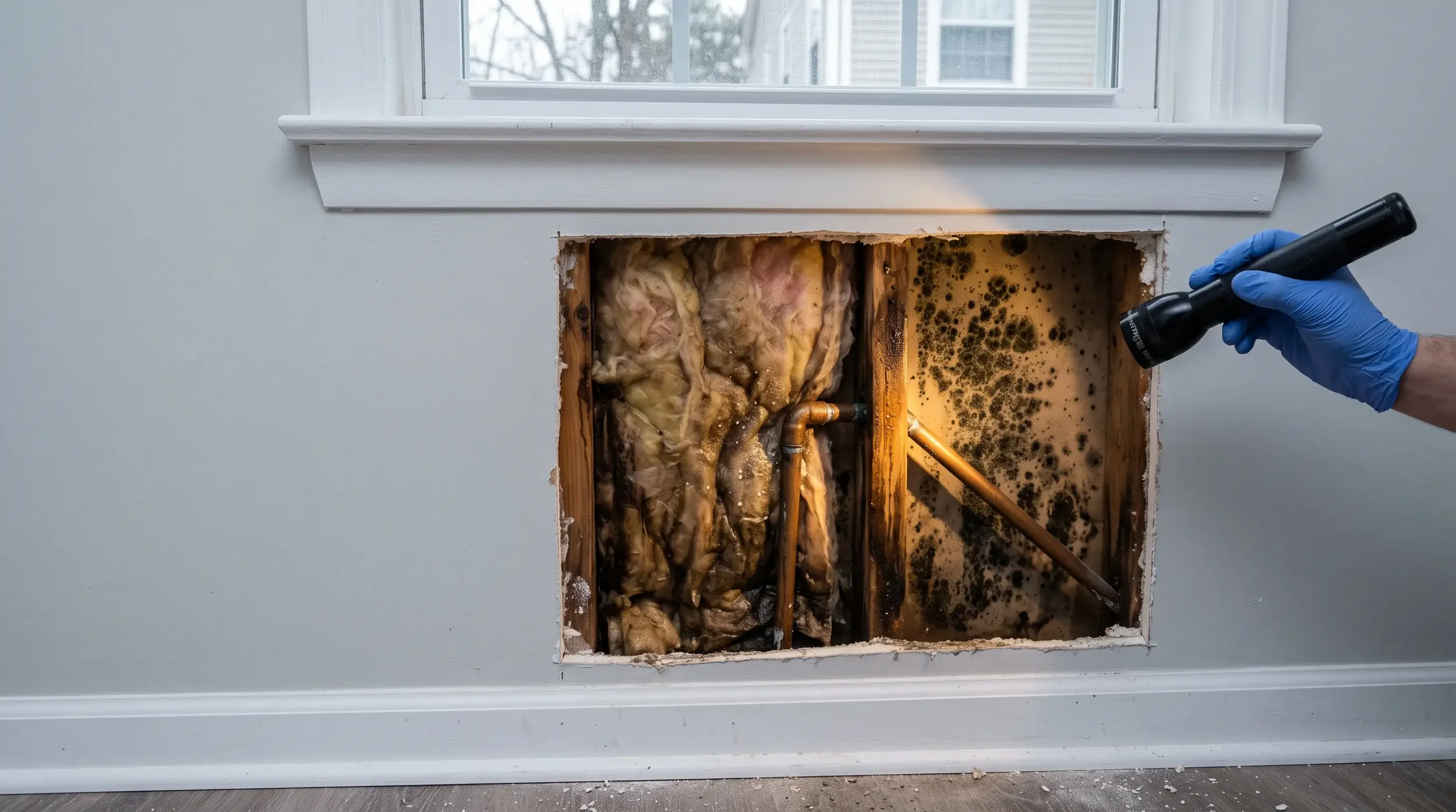
The interior damage was extensive: 900 sq. ft. of engineered hardwood buckled, kitchen cabinets warped from moisture, and drywall was saturated on two walls.
The HVAC system had ingested water through the return vent.
Her HO6 insurer sent an adjuster who scoped the visible water damage — the flooring and one wall of drywall. The estimate was $12,400. After a $5,000 hurricane deductible (percentage-based) and depreciation, the payment was $6,200.
The actual rebuild cost was $94,000. Her Coverage A limit was $20,000 — set at the insurer's default recommendation.
Shoreline Public Adjusters documented the full damage with moisture mapping, thermal imaging, and a complete Xactimate scope that included subfloor replacement, full drywall remediation on both walls, cabinet replacement, HVAC cleaning and duct sanitization, and code upgrade costs the insurer's adjuster omitted entirely. We maximized the HO6 claim to the policy limit of $20,000 minus the deductible, then separately pursued the association's master policy for the exterior wall and sliding door damage — which was the proximate cause of the interior loss.
The HO6 paid $15,000. The master policy paid $62,000 for the exterior breach and the portion of interior damage attributable to the building envelope failure. Total recovery: $77,000 on a claim she was initially told was worth $6,200.
The $17,000 gap between total recovery and actual rebuild cost was the Coverage A shortfall — the direct consequence of carrying $20,000 in dwelling coverage on a unit that needed $94,000 to rebuild.
Does your condo insurance feel like it's set too low — or has your claim already come back short? A free consultation with Shoreline Public Adjusters takes 15 minutes and costs you nothing. We handle both HO6 and master policy claims simultaneously. Contact Us
Common Mistakes Condo Owners Make When Setting Coverage Limits
1. Using the "20% of purchase price" rule for dwelling coverage This formula has no connection to rebuild cost. A $200,000 unit doesn't cost $40,000 to rebuild the interior — it costs $80,000–$120,000 under a bare walls-in master policy. The 20% rule was invented by insurance aggregators to simplify a decision that requires actual calculation. What to do instead: Calculate Coverage A from interior square footage × local rebuild cost per square foot, plus the replacement cost of upgrades.
2. Not knowing the master policy type If you don't know whether your association carries bare walls-in, single entity, or all-in coverage, every coverage decision you make is a guess. Most condo owners discover the answer after a claim — when the gap is already a financial reality. What to do instead: Request the certificate of insurance from your board. In Florida, they must provide it within 30 days under § 718.111.
3. Keeping the default loss assessment limit The $1,000 default is meaningless after any major common-area loss. One hurricane deductible shortfall can generate assessments of $5,000–$15,000 per unit. A $1,000 limit covers none of it. What to do instead: Increase to $25,000 minimum in hurricane zones. The premium increase is negligible.
4. Not updating coverage after renovations If you upgraded your kitchen, bathrooms, or flooring, your Coverage A needs to reflect the replacement cost of those improvements — not the original builder-grade finishes. Without documentation, the insurer pays for laminate when you installed hardwood. What to do instead: Keep receipts and photos of all renovations. Update your HO6 policy after every major improvement.
5. Assuming the master policy covers your interior after a common-area failure When a pipe bursts in the common area and floods your unit, the master policy covers the pipe repair and common-area damage. Your unit interior — flooring, cabinets, drywall, contents — is your HO6 claim. If your Coverage A is too low, the master policy won't fill the gap. What to do instead: Understand exactly where the master policy's coverage ends and your HO6's begins. File both claims simultaneously if damage crosses that boundary.
Frequently Asked Questions About Condo Insurance Coverage
What is the rule of thumb for condo insurance?
The most reliable rule is to base your HO6 dwelling coverage on your master policy type and your unit's actual interior rebuild cost — not a percentage of market value. Under a bare walls-in master policy, Coverage A should equal your interior square footage multiplied by local rebuild cost per square foot, plus any upgrades.
How much condo insurance do I need in Florida?
Under Florida's most common master policy type (bare walls-in), you need enough Coverage A to rebuild your entire unit interior. For a 1,200 sq. ft. unit with mid-grade finishes, expect $80,000–$120,000. Add $50,000–$100,000 in personal property coverage and $25,000–$50,000 in loss assessment coverage.
Is 20% of my condo's value enough for dwelling coverage?
Almost never. The 20% rule produces dangerously low limits under a bare walls-in master policy. A $200,000 unit would yield $40,000 in Coverage A — but the interior rebuild cost on a 1,200 sq. ft. unit can exceed $100,000.
The formula ignores construction costs, finish quality, and master policy type entirely.
What does loss assessment coverage pay for?
Loss assessment coverage pays your share when the condo association assesses unit owners for a loss that exceeds the master policy's limits or deductible. After a hurricane, association deductibles of $200,000–$500,000 get split across all unit owners. Default limits of $1,000 cover almost none of that exposure.
Should I get replacement cost or actual cash value on my HO6?
Replacement cost. ACV policies deduct depreciation from every item, reducing your payout to a fraction of actual repair cost. On a 10-year-old condo interior, ACV depreciation can reduce a $60,000 claim to $25,000. The premium difference between ACV and replacement cost is typically $100–$200 per year.
Can a public adjuster help if my condo insurance claim is underpaid?
Yes. A public adjuster documents the full scope of damage — including hidden moisture, mold, and code upgrade costs the insurer's adjuster typically omits — and negotiates a higher settlement. On condo claims where damage crosses the master policy boundary, a PA can file both claims simultaneously and coordinate both recoveries.
If your condo insurance limits feel wrong — or if your claim already came back too low, that's exactly the situation Shoreline Public Adjusters resolves. We represent condo unit owners across Florida, Minnesota, and Wisconsin. We don't collect a fee unless you do, and insurance claims have deadlines. Contact Us
You may also find these helpful:
- What Is an HO6 Insurance Policy? Coverage, Gaps, and Claims
- What Does a Condo Association Insurance Policy Cover?
- HOA Insurance Claim Support
Shoreline Public Adjusters, LLC is licensed in Florida (FL G199012), Minnesota (MN 40962416), and Wisconsin (WI 21156868).
Shoreline Public Adjusters, LLC
780 Fifth Avenue South
Suite #200
Naples, FL 34102
Email: hello@teamshoreline.com
Phone: 954-546-1899
Fax: 239-778-9889