Wisconsin Ice Dam Insurance Claims: What Homeowners Need to Know Before Filing
By: Shoreline Public Adjusters
Updated: March 2026 · 10 min read
In This Post:
- What Ice Dams Are and Why They Cause So Much Damage in Wisconsin
- Wisconsin Ice Dam Coverage: What Your Policy and Wis. Stat. 628.46 Actually Say
- What Insurers Actually Pay vs. What Ice Dam Damage Actually Costs
- The Hidden Damage Insurers Miss on Every Ice Dam Claim
- How to File a Wisconsin Ice Dam Insurance Claim the Right Way
- Real Outcome: Green Bay Homeowner After Ice Dam Underpayment
- When to Hire a Public Adjuster for an Ice Dam Claim
- Common Mistakes on Wisconsin Ice Dam Claims
- Frequently Asked Questions About Ice Dam Insurance Claims
The insurer's estimate was $4,800. The actual damage was $31,600. The difference wasn't a disagreement about the ice dam — it was everything the insurer's adjuster didn't look behind, above, or underneath.
A homeowner near Green Bay had ice dams form along the north-facing eaves during a January cold snap. Water backed up under the shingles, ran down the interior wall cavities, saturated the insulation, and stained two bedroom ceilings.
The insurer's adjuster scoped the ceiling stains and one section of drywall. Nothing else.
What Ice Dams Are and Why They Cause So Much Damage in Wisconsin
I spent over a decade in enterprise risk management before becoming a licensed public adjuster. Ice dam claims are the most consistently underscoped claim type I see in Wisconsin — and it's because the visible damage is a fraction of what's actually there.
An ice dam forms when heat escapes through the roof deck, melting snow on the upper portion of the roof. The meltwater runs down to the eaves, where the roof surface is colder, and refreezes into a ridge.
Over days and weeks, this ice ridge grows until it traps meltwater behind it. That standing water has nowhere to go but under the shingles and into the roof deck, wall cavities, and interior spaces below.
In Wisconsin, ice dams are not rare events — they're a near-annual certainty in most of the state. The freeze-thaw cycle from December through March creates ice dams on thousands of homes every winter.
The Wisconsin Office of the Commissioner of Insurance receives complaints every spring from homeowners whose ice dam claims were underscoped or denied. Older housing stock with inadequate attic insulation makes the problem worse. Cities like Milwaukee, Madison, Green Bay, and the Fox Valley corridor see the highest concentration of claims.
Wisconsin Ice Dam Coverage: What Your Policy and Wis. Stat. 628.46 Actually Say
Yes — with important limitations. Standard Wisconsin homeowner policies (HO-3) cover the water damage caused by ice dams. The ice dam itself is a weather event, and the resulting water intrusion is sudden and accidental from the policy's perspective.
What's covered:
Water damage to ceilings, walls, insulation, flooring, and personal property caused by ice dam meltwater intrusion. Structural damage to the roof deck if the ice dam compromised the sheathing. Mold remediation if mold develops in the wet wall cavities or attic space after the event.
What's typically NOT covered:
The cost of removing the ice dam itself. Most policies exclude ice dam removal as a maintenance expense, though some cover it as a reasonable mitigation measure if the removal prevents further damage to the structure. The distinction matters — if you can frame removal as mitigation (preventing additional water intrusion to an already-damaged structure), the insurer may cover it.
Damage to the gutters caused by ice weight. Gutter damage from ice accumulation is typically classified as maintenance or wear and tear, not as a covered peril.
Damage attributable to "repeated seepage" if the insurer can show the ice dam condition existed over multiple seasons and you didn't address it. This is the maintenance exclusion applied retroactively — and it's the most common denial tactic on ice dam claims.
⚠️ What Insurers Won't Tell You: Wisconsin homeowner policies cover the water damage from ice dams, but insurers routinely underscope the claim by documenting only the visible ceiling stains. The water that caused those stains traveled through wall cavities, saturated insulation, and pooled in areas the adjuster never inspected. The visible damage is typically 15–25% of the total claim value.
What Insurers Actually Pay vs. What Ice Dam Damage Actually Costs
The gap between what insurers pay on ice dam claims and what the damage actually costs to repair is larger than on almost any other claim type. The reason is structural: ice dam damage is mostly hidden.
The insurer's adjuster sees: Ceiling stains. One or two sections of damaged drywall. Maybe a buckled piece of trim. Their estimate covers paint, drywall patches, and stain-blocking primer. Total: $3,000–$8,000.
What's actually there: Saturated attic insulation that has lost its R-value and must be removed and replaced. Moisture in the wall cavities behind the drywall on the exterior wall — running from the roof line to the first floor. Subfloor moisture if water tracked down to the floor assembly. Mold growth in the wall cavities and attic space that developed in the days or weeks between the intrusion event and the inspection. Damaged roof deck sheathing where water sat beneath the shingles for weeks. Total: $15,000–$50,000+.
The typical insurer payment on a Wisconsin ice dam claim: $3,000–$8,000. The typical actual repair cost: $15,000–$40,000. That gap is not an accident — it's the result of an inspection that documents surfaces and ignores what's behind them.
The Hidden Damage Insurers Miss on Every Ice Dam Claim
Ice dam water follows a path from the roof edge, under the shingles, through the roof deck, down the exterior wall cavities, and into the floor assembly below. The insurer's adjuster inspects the endpoint — the ceiling stain — without tracing the full path.
Attic insulation. Meltwater that enters through the roof deck saturates blown-in or batt insulation in the attic. Wet insulation loses its thermal performance and doesn't recover when it dries. It must be removed and replaced. Most insurer estimates omit this entirely.
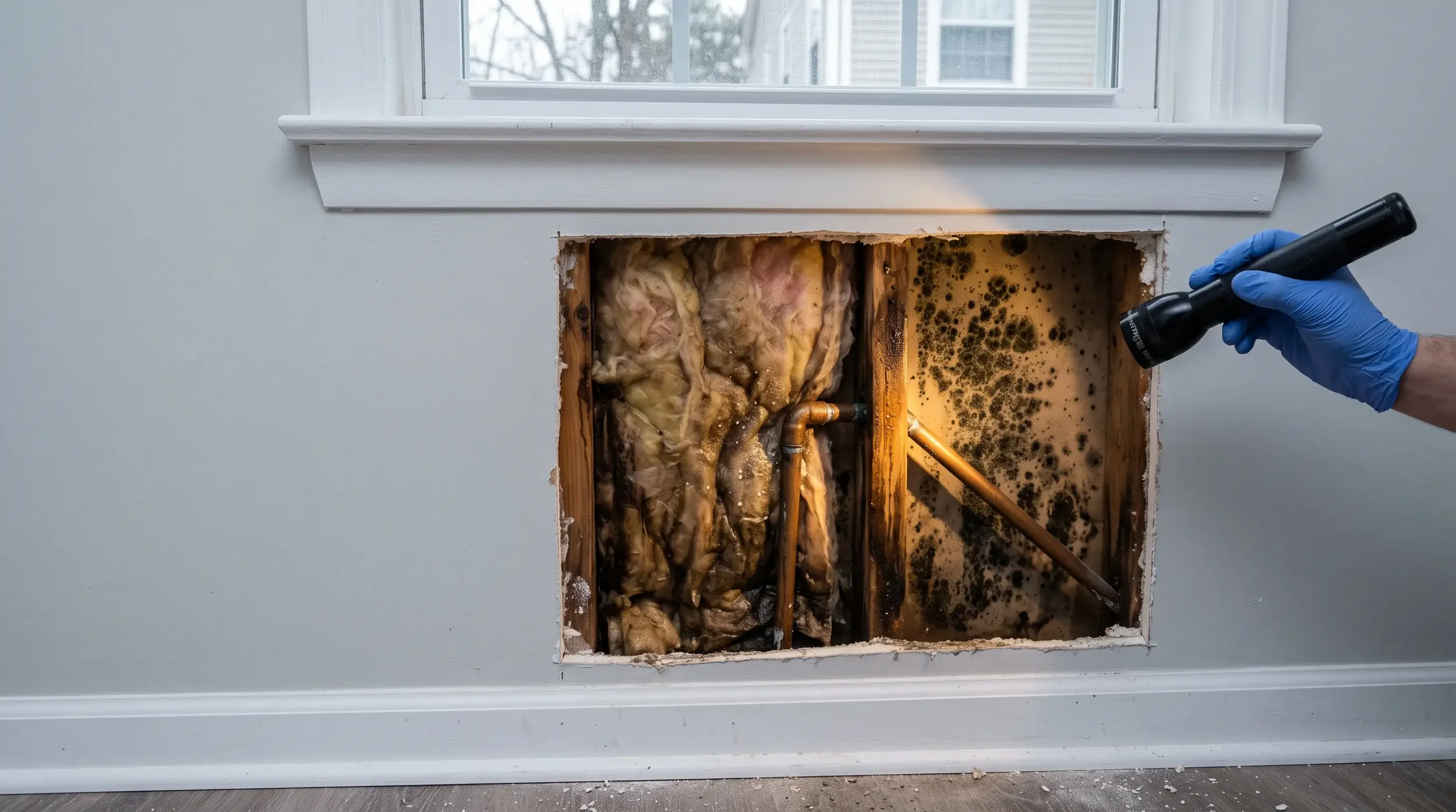
Exterior wall cavities. Water runs down the inside of the exterior wall from the eave line. It soaks the fiberglass insulation, wets the drywall from the backside, and creates conditions for mold growth that isn't visible without removing the drywall or using a moisture meter. This is the single largest underscoped damage category on ice dam claims.
Roof deck sheathing. Standing water behind the ice dam can delaminate OSB or plywood sheathing over time. The damage isn't visible from inside the attic unless you know what to look for — soft spots, discoloration at the seams, and delamination at the edges. If the sheathing is compromised, it must be replaced when the roof is repaired.
Mold. Wisconsin's winter humidity levels inside wall cavities are lower than summer, but ice dam moisture introduces liquid water into enclosed spaces. Mold can colonize within 48–72 hours of sustained moisture contact. By the time the insurer's adjuster arrives — often 10–21 days after the event — mold growth may already be present behind the drywall and in the attic.
How to File a Wisconsin Ice Dam Insurance Claim the Right Way
Document everything before removing the ice dam. Photograph the ice dam itself from multiple angles — the exterior ridge, the icicle formations at the eaves, and any visible water intrusion at the soffit or wall junction. Photograph interior damage as you discover it. Video is even better.
Mitigate immediately. Create channels in the ice dam (using calcium chloride socks or professional steam removal) to allow trapped water to drain. Extract standing water inside the structure. Set up fans and dehumidifiers to begin drying. Keep all receipts — mitigation costs are typically covered.
File the claim promptly. Under Wisconsin law, your policy requires timely notice of loss. File the claim as soon as you discover the water intrusion — don't wait for the ice dam season to end. Delaying the claim gives the insurer ammunition for a "failure to mitigate" or "repeated seepage" argument.
Request moisture mapping during the adjuster's inspection. When the insurer's adjuster arrives, ask whether they'll be using a moisture meter on the walls and attic space. Most won't — they scope the visible damage. If they don't moisture-map, you have a documented basis for an independent inspection that reveals the hidden damage.
📋 Wisconsin Law: Wis. Stat. § 628.46 is titled "Timely payment of claims." It makes a claim overdue if it is not paid within 30 days after the insurer receives written notice of the loss and its amount, or 30 days after the proof of loss where the policy requires one. Overdue payments carry simple interest at 7.5 percent per year. So if your claim is sitting unpaid a month after you documented the moisture in the wall cavities and attic, that section gives you something specific to cite - and a statutory consequence attached to the delay. Source: Wisconsin Legislature
Real Outcome: Green Bay Homeowner After Ice Dam Underpayment
A homeowner near Green Bay, Wisconsin called us after receiving an insurer's estimate of $4,800 for ice dam water damage. The damage was visible on two bedroom ceilings and one section of exterior wall drywall on the second floor.
The insurer's adjuster scoped ceiling drywall replacement, paint, and one section of wall drywall. Nothing behind the walls. Nothing in the attic.
No moisture readings were taken.
We conducted a full inspection with thermal imaging and moisture meters. What we found behind the visible damage changed the scope entirely.
The entire north-facing exterior wall cavity — from the eave line to the first floor — was saturated. Blown-in cellulose insulation in the attic had absorbed meltwater and compressed, losing 60% of its R-value.
The roof deck sheathing above the ice dam showed early delamination at two seams. Mold was present behind the drywall on the second-floor exterior wall — not visible until we opened a test cut.
Our Xactimate estimate included full insulation removal and replacement in the affected attic bays, drywall removal and replacement on the exterior wall (second floor and first floor where moisture had tracked down), mold remediation in the wall cavities and attic space, roof deck sheathing replacement (two sheets), and code-required vapor barrier installation.
Total Xactimate scope: $31,600. The insurer's original estimate: $4,800.
After negotiation with our full documentation — moisture readings, thermal images, mold lab results, and the complete Xactimate scope — the insurer agreed to $29,200.
If your Wisconsin ice dam claim came back at $3,000–$8,000 and the damage looks worse than that, you're probably right. A free consultation with Shoreline Public Adjusters takes 15 minutes. We inspect the hidden damage, build the real scope, and negotiate the full settlement. No fee unless we recover. Contact Us
When to Hire a Public Adjuster for an Ice Dam Claim
Ice dam claims are the clearest case for a public adjuster in Wisconsin. The gap between the insurer's surface-level estimate and the actual hidden damage is consistently the largest of any residential claim type.
Call a PA when:
The insurer's estimate is under $10,000 but the damage affects walls, ceilings, and the attic. The hidden damage is almost certainly 3–5x the insurer's number.
You see mold or smell musty conditions in the affected area. Mold remediation adds $5,000–$15,000 to the scope, and the insurer won't scope it without documented lab results.
The insurer denied the claim for "maintenance" or "repeated seepage." These denials are challengeable if the ice dam formed during a specific weather event and you reported the damage promptly.
The damage spans multiple rooms or floors. Water that enters at the eave travels down wall cavities — if two floors are affected, the hidden damage in the wall assembly between them is substantial.
Shoreline Public Adjusters serves Wisconsin homeowners across the entire state. We handle ice dam claims from intake through final settlement.
Common Mistakes on Wisconsin Ice Dam Claims
1. Removing the ice dam before documenting it The ice dam is the physical evidence that a covered event occurred. If you remove it before photographing the exterior buildup and the visible water intrusion points, the insurer can argue the damage came from another source. What to do instead: Photograph and video the ice dam from multiple angles before removal. Document the water entry points at the eaves and soffit.
2. Accepting the insurer's surface-level estimate If the estimate covers ceiling patches and paint but doesn't include wall cavity moisture, attic insulation replacement, or mold remediation, it's underscoped. The visible ceiling stain is 15–25% of the total damage. What to do instead: Request moisture readings during the insurer's inspection. If they refuse, hire an independent inspector or public adjuster.
3. Not filing until the ice dam season ends Waiting until spring to file means months of additional moisture exposure in the wall cavities and attic. Mold grows. Insulation degrades further. The insurer argues you failed to mitigate. What to do instead: File the claim as soon as you discover the intrusion. Mitigate immediately. Don't wait for the ice to melt.
4. Ignoring the attic The attic is where the water enters the structure from the roof deck. If the insurer's adjuster didn't inspect the attic — and many don't on ice dam claims — the most significant damage category isn't in the claim at all. What to do instead: Insist on an attic inspection. If the adjuster declines, document that refusal in writing and hire an independent inspector.
5. Not documenting mitigation expenses Ice dam removal, emergency water extraction, fans, dehumidifiers, and temporary roof repairs are mitigation costs that most policies cover. Without receipts and photos, the insurer won't reimburse them. What to do instead: Keep every receipt. Photograph the mitigation equipment in place. Document the timeline of your mitigation efforts.
Frequently Asked Questions About Ice Dam Insurance Claims
Does homeowners insurance cover ice dam damage in Wisconsin?
Yes. Standard Wisconsin homeowner policies cover the water damage caused by ice dam meltwater intrusion — including damage to ceilings, walls, insulation, flooring, and personal property. The ice dam itself is a weather event, and the resulting intrusion is treated as sudden and accidental.
Does insurance pay for ice dam removal?
Most policies don't cover removal as a standalone expense. However, if removing the ice dam is a reasonable mitigation measure to prevent further damage to an already-affected structure, the cost may be covered. Frame the removal as mitigation, not maintenance, and document the active water intrusion before removal begins.
Why do insurers pay so little on ice dam claims?
Insurers scope the visible damage — ceiling stains and drywall patches — without tracing the water's full path through wall cavities, attic insulation, and subfloor assemblies. The hidden damage is typically 3–5x the visible damage. Independent moisture mapping and thermal imaging reveal the full scope.
Can my ice dam claim be denied for maintenance issues?
Yes, if the insurer can show the ice dam condition existed over multiple seasons and you didn't address the underlying cause (inadequate insulation, poor ventilation). However, ice dams that form during a specific winter weather event on a maintained property are covered events — not maintenance failures. The denial can be challenged with weather data and documentation of the property's condition.
How much does ice dam damage typically cost to repair in Wisconsin?
Full repair costs — including hidden damage in wall cavities, attic insulation replacement, mold remediation, and roof deck repair — typically range from $15,000–$40,000+ for moderate to severe ice dam events. Insurer estimates that cover only surface damage typically come in at $3,000–$8,000.
When should I hire a public adjuster for an ice dam claim?
When the insurer's estimate is under $10,000 but the damage affects walls, ceilings, and the attic. When you see or smell mold in the affected area.
When the insurer denied the claim for maintenance or repeated seepage. A PA conducts moisture mapping, thermal imaging, and builds a complete Xactimate scope that captures the hidden damage the insurer's adjuster missed.
Ice dam claims don't have to end badly. The damage is real, it's covered, and it's almost always larger than the insurer's first estimate. Shoreline Public Adjusters serves Wisconsin homeowners from Milwaukee to Green Bay to Madison and every city in between. We don't collect a fee unless we recover money on your claim. Contact Us
You may also find these helpful:
- Water and Flood Damage Claims
- Public Adjuster in Wisconsin
- Insurance Claim Denied? A Step-by-Step Guide
Shoreline Public Adjusters, LLC is licensed in Florida (FL G199012), Minnesota (MN 40962416), and Wisconsin (WI 21156868).