Hurricane Isaias Insurance Claims: Your Florida Deadlines and Fee Rights
TL;DR — Hurricane Isaias Insurance Claims in Florida: The Clocks and the Fee Rules
- Isaias came ashore near Destin at about 9:30 p.m. on Friday, October 9, as a Category 2 with 105 mph sustained winds. Gusts hit 116 mph near Santa Rosa Sound and 100 mph near Pensacola, and water in Panama City Beach rose about 5.6 feet above average high tide.
- The Governor's emergency declaration changed the rules in your favor, not ours. Under Executive Order 26-202, Florida law caps what any public adjuster may charge on an Isaias claim at 10 percent of the claim payments, for a year. Outside a declared emergency the cap is twice that.
- You also get a longer window to change your mind. Thirty days from the date of loss to cancel a public adjusting contract without penalty, instead of the usual 10 days from signing.
- Your carrier is on a 7-day and a 60-day clock. Seven calendar days to acknowledge your claim, 60 days from notice to pay or deny it. Pay late and the statute adds interest from the day they got notice, and the policy cannot waive that.
- Your own deadline is one year from the date of loss to give notice of the claim, and 18 months for a supplemental. For Isaias that is October 9, 2027 and April 9, 2028.
- One rule almost nobody knows closes on October 23. If your insurer commits to your policy limit for a coverage part within 14 days of the loss, a public adjuster's fee on that part is capped at 1 percent.
- This page is information, not an invitation to file a claim. If your property was not damaged by this storm, you do not have a claim, and nobody should tell you otherwise.
What Isaias Actually Did
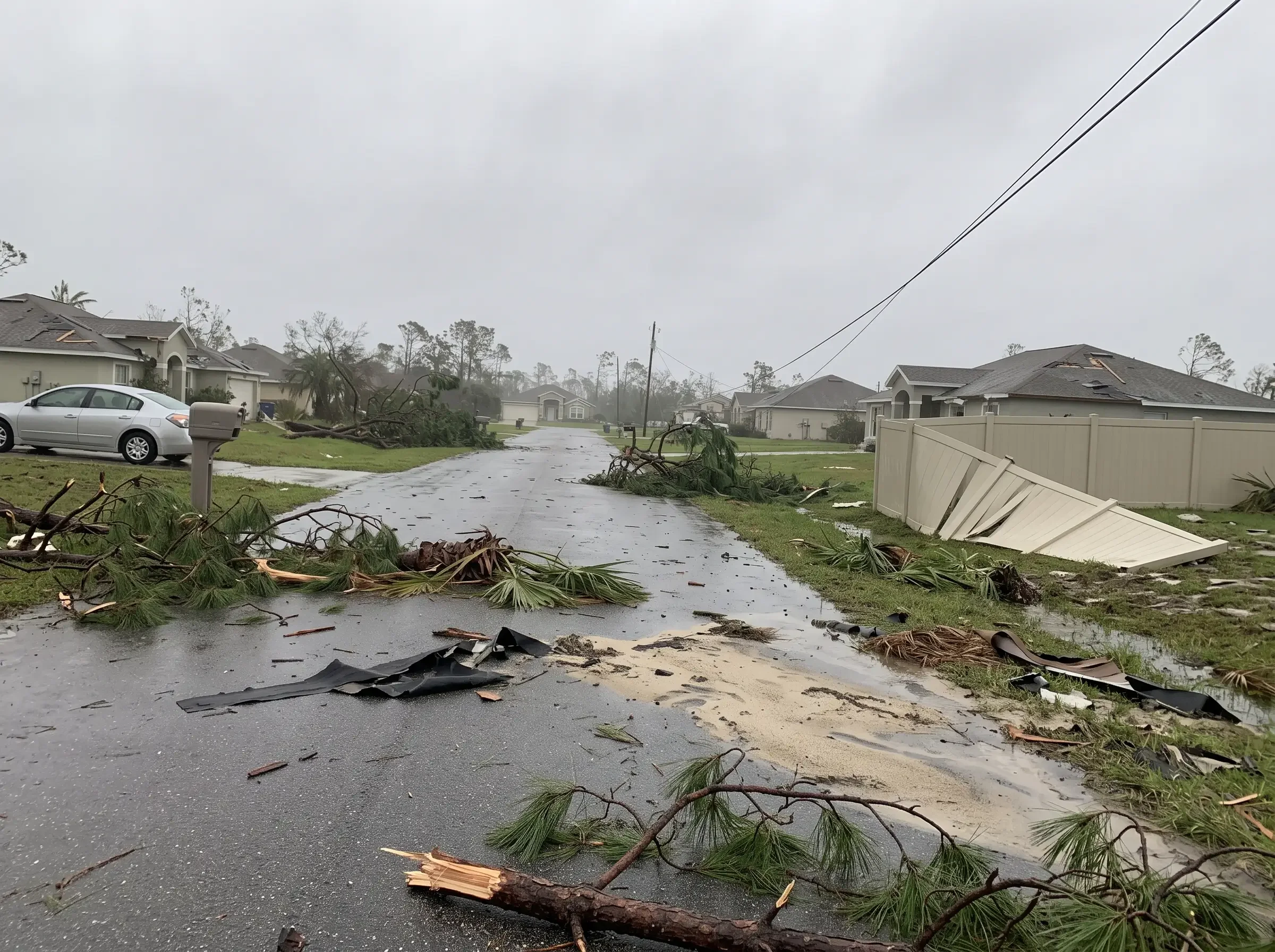
Hurricane Isaias made landfall near Destin at approximately 9:30 p.m. EDT on Friday, October 9, 2026, as a Category 2 hurricane with maximum sustained winds of 105 mph. Those are the state's own figures, not an estimate.
Wind gusts reached 116 mph near Santa Rosa Sound and 100 mph near Pensacola. Water levels at Panama City Beach rose approximately 5.6 feet above the average high tide level. The storm then moved north through the western Panhandle into southern Alabama and weakened to a post-tropical cyclone early Saturday morning.
At the storm's peak roughly 448,000 customer accounts were without power across the state, with more than 16,000 linemen and restoration personnel pre-positioned before landfall.
Those numbers matter for a claim because they are the public record of what the wind and water did in your area on a specific date.
If your carrier later argues that your damage predates the storm, that record is the first thing your file should answer.
Free 15-minute claim review
If Isaias damaged your property and you want a second read on your policy or your carrier's estimate, we will look at it with you. No upfront fee. Our fee comes out of the recovery and is agreed in writing before we start, subject to the statutory cap described below.
The Emergency Declaration Changed Three Things, and Two of Them Cost Us Money
Governor DeSantis issued Executive Order 26-202, amending EO-26-212, declaring a state of emergency for 27 Florida counties. That declaration does more than move resources. It flips three specific provisions of Florida's public adjuster statute.
The fee cap is halved. Under Fla. Stat. § 626.854(11)(b)1, a public adjuster may not charge more than "Ten percent of the amount of insurance claim payments or settlements, exclusive of attorney fees and costs, paid to the insured by the insurer for claims based on events that are the subject of a declaration of a state of emergency by the Governor." The statute adds that this "applies to claims made during the year after the declaration of emergency." For Isaias that runs to roughly October 6, 2027. Outside a declared emergency, § 626.854(11)(b)2 sets the cap at twenty percent.
We are telling you this because you should know it before you talk to anyone, including us. Any public adjuster quoting you more than ten percent on an Isaias claim is quoting you a number the statute does not allow.
Your cancellation window more than doubles. Normally you have 10 days from signing to cancel a public adjusting contract. Because Isaias is the subject of a declaration, § 626.854(7) gives you 30 days after the date of loss or 10 days after signing, whichever is longer — and the statute says that is "without penalty or obligation."
For a Friday loss, that window runs to about November 8. The contract has to state this in large bold type immediately above where you sign. A Department of Financial Services disclosure form has to come with it.
And there is a rule that closes on October 23. Under § 626.854(11)(b)3, where an insurer pays, or commits in writing to pay, the policy limit for a coverage part within 14 days after the date of loss (or within 10 days after you sign a public adjusting contract), a public adjuster's fee on that coverage part is capped at one percent. If your carrier tenders limits fast on a total loss, that is the rule that applies. Fourteen days from Friday, October 9 is October 23, 2026.
Your Carrier's Clocks Started When You Called
Florida sets hard deadlines on your insurer, and they are worth knowing because the single most common thing we see on a storm file is a claim that has simply gone quiet.
Seven calendar days to acknowledge. Under Fla. Stat. § 627.70131(1)(a), once an insurer receives a communication about a claim, it "shall, within 7 calendar days, review and acknowledge receipt of such communication" unless it pays within that time, or unless the delay is caused by factors beyond its control. If the acknowledgment is not in writing, it still has to be logged and dated in the claim file.
Seven days to begin investigating. Under § 627.70131(3)(a), within 7 days after the insurer receives proof-of-loss statements, it "shall begin such investigation as is reasonably necessary" — again, unless the policy or the law says otherwise, or factors outside its control intervene.
Sixty days to pay or deny. This is the one that matters most. Section 627.70131(7)(a) requires that "Within 60 days after an insurer receives notice of an initial, reopened, or supplemental property insurance claim from a policyholder, the insurer shall pay or deny such claim or a portion of the claim."
It must give you a written explanation grounded in the policy. And if it pays you less than its own detailed estimate of the loss, it "must provide a reasonable explanation in writing of the difference."
Two details in that subsection are worth reading twice. A payment made after the 60 days "bears interest at the rate set forth in s. 55.03," and that interest "begins to accrue from the date the insurer receives notice of the claim" — not from day 61.
And the statute states plainly that these provisions "may not be waived, voided, or nullified by the terms of the insurance policy."
If you reported an Isaias loss on Saturday, October 10, your carrier's 60-day deadline to pay or deny lands around December 9, 2026. Put that date in writing somewhere you will see it.
Your Own Deadlines Are Longer Than You Think, and Shorter Than You Need
Florida gives you a year, and the clock runs from the storm rather than from when you noticed the damage.
Under Fla. Stat. § 627.70132(2), a claim or reopened claim "is barred unless notice of the claim was given to the insurer in accordance with the terms of the policy within 1 year after the date of loss." A supplemental claim is barred unless notice was given "within 18 months after the date of loss."
For Isaias, dated to Friday's landfall, that means:
| Deadline | Date | Source |
|---|---|---|
| Carrier acknowledges your claim | 7 calendar days from your first communication | § 627.70131(1)(a) |
| Carrier pays or denies | 60 days from notice — about December 9, 2026 if you reported October 10 | § 627.70131(7)(a) |
| Your fee cap window closes | About October 6, 2027 (one year from EO 26-202) | § 626.854(11)(b)1 |
| Your deadline to give notice of a claim | October 9, 2027 | § 627.70132(2) |
| Your deadline for a supplemental claim | April 9, 2028 | § 627.70132(2) |
A year sounds generous. It is not, for one reason: the damage you cannot see from the ground is the damage that takes longest to surface.
Water that got in through a lifted shingle shows up as a ceiling stain in February. By then the roof it came through has been rained on another dozen times, and proving when it happened is much harder.
The Hurricane Deductible Is Annual, Not Per Storm
This is the point that catches Florida homeowners out most often, and it is written into the statute.
Under Fla. Stat. § 627.701(5)(a)1, the hurricane deductible on a personal lines residential policy "shall apply on an annual basis to all covered hurricane losses that occur during the calendar year for losses that are covered under one or more policies issued by the same insurer or an insurer in the same insurer group."
So the hurricane deductible is not a per-storm charge. It is a per-calendar-year charge. If you had a covered hurricane loss earlier in 2026 under the same insurer or insurer group, you have already spent some or all of it.
Subsection (5)(a)3 completes the picture: where there was a prior hurricane loss in the same calendar year, the insurer may apply to the later storm "the greater of the remaining amount of the hurricane deductible or the amount of the deductible that applies to perils other than a hurricane." The statute also allows insurers to require you to report hurricane losses that fall below the deductible, or to keep receipts, precisely so those losses can be applied to a later claim.
Two practical consequences. If you took a hurricane hit earlier this year and absorbed it yourself without reporting it, that was potentially a mistake worth money now.
And if your property has been through more than one storm this year, work out which deductible applies before you accept any figure. Our Florida hurricane deductible calculator does that arithmetic.
What to Do in the First Two Weeks
Nothing on this list requires hiring anybody, and most of it is easier now than it will be in a month.
- Report the loss to your insurer, in writing, and keep the confirmation. The 7-day and 60-day clocks in § 627.70131 run from that communication, so the date you can prove is the date that counts.
- Photograph everything before you clean up, including the parts that look minor. Wide shots that establish the property, then close shots of each area. Date-stamped if your phone does that.
- Do the emergency repairs you are obliged to do — tarp the roof, board the openings, stop the water — and keep every receipt. Mitigating further damage is your duty under the policy, and the cost of doing it is usually claimable.
- Do not throw out damaged property until it has been photographed and, where it matters, inspected. A pile of soaked drywall at the curb is evidence that no longer exists.
- Write down what the storm did at your address, while you remember it: when the wind peaked, where water came in, when the power went. The state's record says what happened in your region; only you can say what happened at your house.
- Ask for your insurer's estimate in writing, itemized. If their payment is lower than their own estimate, § 627.70131(7)(a) entitles you to a written explanation of the difference.
- Read any contract before you sign it, including ours. On an Isaias claim, three things should be there: a fee no higher than ten percent, the 30-day cancellation language in bold above the signature line, and the Department of Financial Services disclosure form. If any one is missing, that tells you something.
From Our Files
We have no Florida hurricane claim in our own records that has run its full course, so we are not going to describe one. What we can tell you about is what happens when a wind claim's first number turns out not to be its last.
On a Minnesota wind claim in our files, the carrier had made its assessment and the file had effectively stalled. The thing that moved it was a complaint to the state insurance regulator. After that complaint, the carrier conceded additional money it had not previously offered.
Two things in that file transfer to a Panhandle homeowner this month. The first is that a carrier's position on a storm claim is a position, not a finding, and regulators exist because positions sometimes need outside pressure to move. Florida has its own route for that, through the Department of Financial Services.
The second is less comfortable: more than a year on, parts of that claim were still disputed. Storm claims that go sideways do not resolve in weeks. That is the honest expectation to set, and it is the reason the dates above are worth writing down now rather than in February.
We are not offering that file as a typical result. Every claim turns on its own policy, its own damage and its own evidence, and the only thing we claim about this one is what our file records.
Frequently Asked Questions
How much can a public adjuster charge on a Hurricane Isaias claim in Florida?
Ten percent of the claim payments, at most. Because Hurricane Isaias is the subject of Governor DeSantis's Executive Order 26-202 declaring a state of emergency, Fla. Stat. § 626.854(11)(b)1 caps a public adjuster's compensation at ten percent of insurance claim payments or settlements, exclusive of attorney fees and costs. The statute applies that cap to claims made during the year after the declaration. Outside a declared emergency the cap is twenty percent. There is also a one percent cap under § 626.854(11)(b)3 where the insurer commits to paying a policy limit for a coverage part within 14 days of the date of loss.
How long does my insurance company have to pay or deny my Isaias claim?
Sixty days from the date it receives notice of the claim, under Fla. Stat. § 627.70131(7)(a). It must pay or deny the claim or a portion of it in that window and give you a written explanation grounded in the policy. A payment made after 60 days bears interest at the rate set in s. 55.03, accruing from the date the insurer received notice rather than from day 61, and the statute says that provision cannot be waived or nullified by the terms of your policy. Separately, the insurer has 7 calendar days to acknowledge your claim communication under § 627.70131(1)(a).
What is my deadline to file a hurricane claim in Florida?
One year from the date of loss for a claim or a reopened claim, and 18 months from the date of loss for a supplemental claim, under Fla. Stat. § 627.70132(2). Notice must be given in accordance with the terms of your policy. For Hurricane Isaias, which made landfall on October 9, 2026, that is October 9, 2027 for a claim and April 9, 2028 for a supplemental. Those limits are tolled for a servicemember during a term of deployment to a combat zone that materially affects their ability to file.
Does my hurricane deductible apply again for Isaias if I already had a storm this year?
Not necessarily, and this is where Florida homeowners most often overpay. Under Fla. Stat. § 627.701(5)(a)1 the hurricane deductible applies on an annual basis to all covered hurricane losses in the calendar year under policies from the same insurer or insurer group. If you already had a covered hurricane loss in 2026, part or all of that deductible is spent. Under (5)(a)3 the insurer may apply the greater of the remaining hurricane deductible or your all-other-perils deductible to the later storm. Insurers are allowed to require you to report below-deductible hurricane losses so they can be counted later.
Can I cancel a public adjuster contract signed after Hurricane Isaias?
Yes, and you get longer than usual. Because the loss arises from events subject to a declaration of a state of emergency, Fla. Stat. § 626.854(7) lets you cancel without penalty or obligation within 30 days after the date of loss or 10 days after signing, whichever is longer. The contract must carry that language in minimum 18-point bold type immediately before the signature space. You may also cancel if the public adjuster fails to give you and your insurer a written itemized estimate within 60 days of signing, which § 626.854(12)(a) requires.
Which Florida counties were under the emergency declaration for Isaias?
Executive Order 26-202, which amended EO-26-212, declared a state of emergency for 27 Florida counties. The state's own releases name Escambia, Santa Rosa, Okaloosa, Walton, Holmes, Washington, Bay, Jackson, Gadsden, Franklin, Wakulla, Taylor and others across the Panhandle and Big Bend. Because the county list was amended as the storm developed, check the current executive order on the Governor's website rather than relying on an early news report. Whether the declaration covers your county is what determines the ten percent fee cap and the 30-day cancellation right.
Do I have a claim if I am not sure the storm caused my damage?
That is a question to answer with evidence, not with optimism. If your property was not damaged by this storm you do not have a claim for it. Florida law treats it as a deceptive practice for a public adjuster to invite you to submit one anyway. What is worth doing is documenting what you have and getting it looked at, because wind and water damage is often invisible from the ground and worse than it looks from a driveway. An inspection answers the question; a guess does not.
Should I accept my insurer's first payment on an Isaias claim?
You can accept a payment without agreeing that the claim is finished, but read what you are signing before you do. The thing to compare is the insurer's payment against the insurer's own itemized estimate, because § 627.70131(7)(a) requires a written explanation of any difference between the two. If the payment is short of what the repair actually costs, that gap is a supplemental claim, and you have 18 months from the date of loss to give notice of one under § 627.70132(2).
Get a second read before you sign anything
If Isaias damaged your property in the Panhandle or anywhere else in Florida, send us the declarations page and whatever your carrier has sent so far. We will tell you what we see. No upfront fee. On a claim from this storm our fee cannot exceed the statutory ten percent, and it is agreed in writing before we start. You can cancel without penalty within 30 days of the date of loss.
Related Reading
- Public adjuster in Destin, FL — the landfall city, and what a claim looks like for the properties closest to where the eye came ashore.
- Public adjuster in Fort Walton Beach, FL — just west of landfall, where the 116 mph Santa Rosa Sound gusts were recorded.
- Public adjuster in Pensacola, FL — 100 mph gusts, and the far end of the wind field rather than the surge.
- Public adjuster in Panama City, FL — where the water came up about 5.6 feet, which makes the wind-versus-flood question the one that decides the claim.
- Florida hurricane deductible calculator — works out which deductible actually applies if this is not your first hurricane loss of the calendar year.
- Hurricane damage claims — how we handle a hurricane file from first notice through to supplemental.
- The insurance appraisal clause — the route that opens if the storm damage is agreed and only the amount is in dispute.
Sources
- Office of the Governor and the Florida Division of Emergency Management, state response and recovery releases for Hurricane Isaias, October 10, 2026 — landfall location and time, Category 2 and 105 mph sustained winds, 116 mph gusts near Santa Rosa Sound, 100 mph near Pensacola, approximately 5.6 feet of water above average high tide at Panama City Beach, Executive Order 26-202 amending EO-26-212 declaring a state of emergency for 27 counties, and the power outage figures (verified 2026-10-12)
- Fla. Stat. § 626.854 — public adjuster definition and conduct; (5) solicitation days and hours, (7) cancellation including the emergency window, (8)(a) statements deemed deceptive or misleading, (11)(b)1 the ten percent emergency fee cap, (11)(b)2 the twenty percent cap, (11)(b)3 the one percent cap, (12)(a) the 60-day written estimate (verified 2026-10-12)
- Fla. Stat. § 627.70131 — (1)(a) 7-day acknowledgment, (3)(a) 7 days to begin investigating, (7)(a) 60 days to pay or deny plus s. 55.03 interest and the non-waiver provision (verified 2026-10-12)
- Fla. Stat. § 627.70132 — (2) one year to give notice of a claim or reopened claim, 18 months for a supplemental, with the combat-deployment tolling (verified 2026-10-12)
- Fla. Stat. § 627.701 — (5)(a)1 the hurricane deductible applied on an annual calendar-year basis, (5)(a)3 the greater-of rule for a later hurricane in the same year (verified 2026-10-12)
This page is general information about Florida claim deadlines and public adjuster fee rules after Hurricane Isaias. It is not legal advice and it does not create a professional relationship. It is not issued by or endorsed by any government agency.
Shoreline Public Adjusters, LLC is a licensed public adjusting firm and is not a law firm. Licensed in Minnesota (MN 40962416), Wisconsin (WI 21156868), Florida (FL G199012), North Dakota (ND 3004392416), and South Dakota.
Shoreline Public Adjusters, LLC
780 Fifth Avenue South
Suite #200
Naples, FL 34102
Email: hello@teamshoreline.com
Phone: 954-546-1899
Fax: 239-778-9889