
Why Do Insurance Companies Deny Claims? (7 Tactics, Decoded)
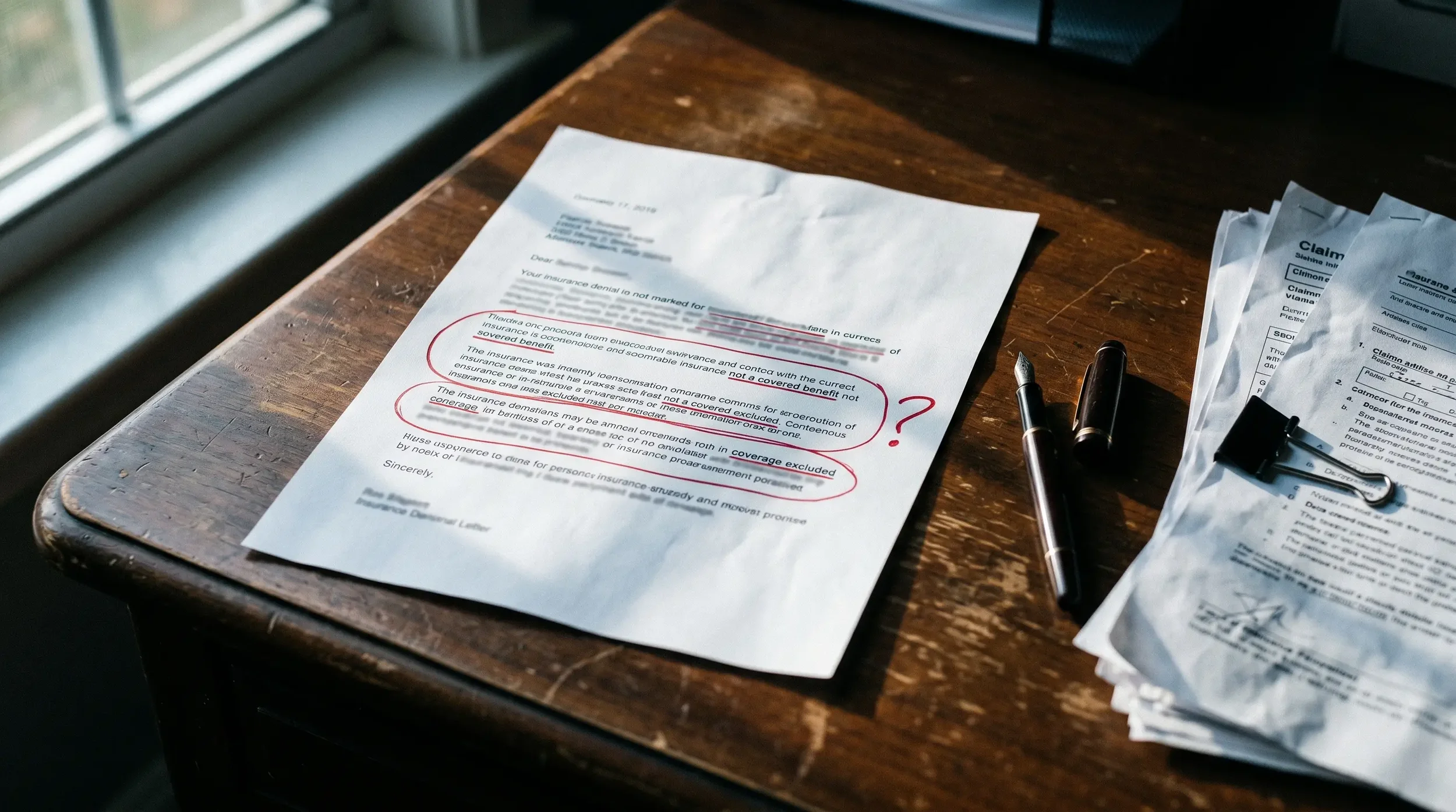
Insurance claim denials aren't random. After 1,000+ claims handled, the same seven tactics show up again and again — each with specific policy language insurers cite, each with a specific defense if you know what you're looking at. This is the decoder ring.
Some denials are legitimate. Most aren't. The difference comes down to whether the insurer's cited policy language actually applies to your loss, and whether you have the documentation to prove it. This guide walks through the seven tactics in order of frequency, what each one looks like on a denial letter, and how to fight back.
Free 15-minute claim review
Got a denial letter and don't know what it means? We'll read it and tell you whether the denial holds up — no obligation.
Get a free claim review →The business reality: why denials are a profit lever
Before the tactics, the why. Insurance is a business, and claims are the largest line item on an insurer's profit and loss statement. Every dollar paid in a claim reduces underwriting profit by a dollar. Every claim that's denied, partially denied, or settled below actual cost lifts profit margin.
This isn't a moral judgment — it's the structural incentive of the industry. Insurers aren't villains for trying to reduce claim payouts. Their adjusters aren't dishonest people. But the financial reality means insurer-side staff is trained, measured, and rewarded based on closing claims for the lowest defensible amount. Denial — or partial denial dressed up as approval — is the most efficient tool.
The tactics below aren't conspiracy. They're standard operating procedure. Recognizing them is the first step to defeating the ones that don't actually apply to your loss.
Tactic 1: Pre-existing damage allegations
The single most common denial reason. The insurer alleges that the damage existed before the loss event you filed on, shifting the burden onto you to prove the damage is new.
What it looks like on a denial letter: "Our investigation indicates the damage you reported predates the loss date and is therefore excluded under [policy section X]." Or: "The condition observed is consistent with long-term deterioration, not the sudden loss event described."
Why insurers invoke it: "Pre-existing" is impossible for most homeowners to disprove. Few people have date-stamped pre-loss photos of every roof shingle, every wall stud, every appliance. Without that documentation, the insurer's adjuster's word becomes the operative truth.
The defense:
- Dated pre-loss photos. Any photos taken of the property in the prior 1-5 years that show the now-damaged areas in good condition. Real estate listing photos from when you bought the home are gold.
- Weather records. National Weather Service storm reports for the date of loss showing the event was severe enough to cause the damage type. Hail-pad data, wind speeds, tornado paths — all verifiable through NWS Storm Prediction Center records.
- Neighborhood damage patterns. If your neighbors filed claims for the same storm and have visible repairs, the cohort data supports a single-event cause. Your roof shouldn't be the only one in the neighborhood with hail damage.
- Inspection records. Real estate inspection reports, prior insurance company photos from earlier underwriting reviews, building permit records — any third-party record from before the loss.
- Independent expert opinion. Roofing contractor, engineer, or industrial hygienist who can document the damage's specific cause and timing.
Tactic 2: Wear-and-tear exclusions
Every homeowners policy excludes "wear and tear," "gradual deterioration," and "normal aging." Insurers use these exclusions even on sudden, event-driven damage by arguing the damage is consistent with age rather than the storm/loss.
What it looks like on a denial letter: "The damage observed is consistent with normal wear and tear and gradual deterioration, which is excluded under [policy section]." Or: "Our inspection indicates the damage is the result of ongoing maintenance issues rather than a covered peril."
Why insurers invoke it: Wear-and-tear exclusions are universally enforceable — every standard policy has them. They're easy to assert and hard to refute without expert testimony showing the damage is event-caused, not age-related.
The defense:
- Date-stamped pre-loss photos showing the property's condition before the loss (same defense as Tactic 1).
- Storm-specific damage patterns. Hail impact damage looks different than UV-driven shingle deterioration. Wind-uplift damage looks different from age-related shingle slippage. An experienced roofing contractor or engineer can distinguish event-caused from age-caused damage.
- Neighborhood cohort evidence. If the same storm caused damage to neighbors with newer roofs, the wear-and-tear argument falls apart.
- Weather event correlation. Did the damage appear after the date of a documented storm? The temporal correlation is evidence.
Tactic 3: Late notice / failure to cooperate
Most policies require "prompt" notice of a loss and ongoing cooperation with the insurer's investigation. Insurers use these obligations to deny claims when notice or cooperation was anything less than perfect.
What it looks like on a denial letter: "You failed to provide timely notice of the loss as required under [policy condition]." Or: "Your failure to cooperate with the requested examination under oath voids coverage under this claim."
Why insurers invoke it: Notice and cooperation requirements are real policy conditions. If a homeowner reports a loss weeks or months after it happened, or misses a requested document deadline, the insurer has a contractual basis to deny.
The defense:
- "Prompt" is interpreted, not strictly defined. Most state courts have held that "prompt" means within a reasonable time given the circumstances. A 30-60 day delay due to ongoing damage assessment is typically defensible. A multi-month delay without justification is harder.
- Document all notice attempts. Phone calls log dates and durations. Emails and certified letters create paper trail. If you noticed a loss within a week and called twice, you reported promptly even if the insurer's records are incomplete.
- Florida's prompt-pay obligation cuts both ways. F.S. 627.70131 requires Florida insurers to acknowledge claims within 14 days and pay or deny within 60 days of receiving proof of loss (90 days for declared emergencies). If they invoke "late notice" on you, ask whether their own response timeline complied.
- "Failure to cooperate" requires the insurer to prove material prejudice. In most states, an insurer can't deny on cooperation grounds unless they can show how the alleged failure actually harmed their investigation. A missed deadline doesn't automatically void coverage if you can produce the requested document later.

Tactic 4: Anti-concurrent causation clauses (Florida hurricane specific)
This is the Florida hurricane denial tactic. Anti-concurrent causation (ACC) clauses exclude coverage when a covered peril (wind) and an excluded peril (flood) occur together — even if the covered peril did the visible damage. Florida insurers use ACC to deny otherwise-covered hurricane claims by arguing storm surge or rising water contributed to the loss.
What it looks like on a denial letter: "Coverage is excluded where flood or surface water concurrently contributes to the loss, regardless of whether wind or another covered peril is also involved. Because flood waters were present at the property during the loss event, this claim is excluded under [ACC policy provision]."
Why insurers invoke it: Hurricanes by definition involve both wind and water. ACC clauses let insurers default-deny most hurricane claims unless the policyholder can isolate wind damage timing from flood damage timing. Most homeowners can't.
The defense:
- Damage timing documentation. Wind damage that occurred before storm surge arrival is covered. Hour-by-hour weather data from NWS, security camera footage, neighbor video, news coverage — anything that establishes wind damage preceded the water.
- Damage location separation. Roof, soffits, second-story interiors, and upper walls are typically wind-only damage zones. Even if ACC applies to first-floor flood damage, it doesn't necessarily apply to upper-floor wind damage.
- Engineering analysis. Forensic engineers can document distinct damage patterns and assign causation by mechanism — wind-driven rain through a wind-damaged opening is covered under HO-3, even when rising water below isn't.
- Florida case law developments. Several Florida court decisions have narrowed insurer ACC defenses where evidence shows wind damage preceded or was independent of flood. The legal landscape is evolving in policyholder favor.
The full deep-dive on this tactic is in our anti-concurrent causation guide for Florida hurricane claims.
Tactic 5: Maintenance / neglect exclusions
Closely related to wear-and-tear but applied differently. Maintenance exclusions deny claims by arguing the homeowner failed to maintain the property in a way that prevented the loss.
What it looks like on a denial letter: "Our inspection indicates the loss resulted from inadequate maintenance of [roof / plumbing / HVAC / etc.]. Damage caused by failure to maintain the dwelling is excluded under [policy section]."
Why insurers invoke it: Maintenance exclusions create a fault-shifting argument. If the insurer can frame the damage as the homeowner's fault rather than an external peril, the loss is excluded regardless of how dramatic the precipitating event was.
The defense:
- Maintenance records. Annual roof inspections, HVAC service records, plumbing repair invoices — anything documenting reasonable maintenance.
- The "reasonable" standard. Most state courts apply a "reasonable maintenance" standard, not "perfect maintenance." Annual or biennial inspections of major systems typically meet the standard.
- Distinguishing causation. Even if maintenance was imperfect, the question is whether maintenance failure caused the loss or whether the storm/event caused it. Documentation showing event-driven damage patterns defeats maintenance-cause arguments.
Tactic 6: Material misrepresentation allegations
The nuclear option. Material misrepresentation lets insurers rescind coverage entirely — not just deny a specific claim — by alleging that information on the original application was false or incomplete in a way that "materially" affected the underwriting decision.
What it looks like on a denial letter: "Our investigation revealed material misrepresentations on your application regarding [prior claims / occupancy / roof age / smoke detectors / etc.]. Pursuant to [state statute on rescission], your policy is hereby rescinded and your claim is denied."
Why insurers invoke it: Rescission isn't just denying a claim — it's voiding the policy as if it never existed. The insurer refunds premiums and walks away from all coverage. It's the most powerful tool in the denial playbook and increasingly common on large claims.
The defense:
- Materiality matters. Most state statutes require the misrepresentation to be "material" — meaning the insurer wouldn't have written the policy or would have charged a different premium if they'd known the truth. Minor errors typically don't meet that standard.
- Intent matters in some states. Some jurisdictions require the misrepresentation to have been knowing or intentional. Honest mistakes on application forms aren't always grounds for rescission.
- Review your application annually. If you bought the home recently or changed occupancy, update the insurer in writing. Documented updates create paper trail that defeats later "we never knew" allegations.
- This is when to hire an attorney. Rescission disputes often require litigation. Public adjusters can document and quantify; attorneys argue the rescission's validity under state law.
Tactic 7: Lowball "approved" settlements (not technically denial)
The most overlooked tactic. The insurer approves the claim — but for a fraction of actual cost. Because it's technically an approval, many homeowners cash the check without realizing they had grounds to negotiate.
What it looks like: A settlement letter offering $8,500 on a $35,000 loss. The letter cites covered policy provisions and approves payment. No denial. Just a number that's way below what the actual repair will cost.
Why insurers do this: Statistics favor the insurer. Most homeowners don't have contractor estimates ready to compare. Most accept the first offer because they want the claim resolved. Most don't know they can invoke the policy's appraisal clause to challenge the amount without filing a lawsuit. The math: paying 25-50% of a claim's actual value and getting acceptance is hugely profitable compared to paying 100%.
The defense:
- Don't accept the first offer. Get an independent contractor estimate before responding. If the gap is significant (more than 15-20%), the offer is negotiable.
- Invoke the policy's appraisal clause. Most policies allow either party to demand binding appraisal when the amount of loss is disputed. Each side selects an appraiser; the two appraisers select a neutral umpire; the umpire decides disputes. This is much faster and cheaper than litigation.
- File a state DOI complaint as parallel pressure. Florida OIR, Minnesota Department of Commerce, Wisconsin OCI — all accept formal complaints about insurer claim practices. The complaint creates regulatory pressure even before resolution.
- Get a public adjuster review. Underpaid claims are PA bread-and-butter. The contingency fee comes from the additional recovery; if there's no additional money to recover, you owe nothing. See our denied vs underpaid guide for the distinction.
The difference between a wrongful denial and a legitimate one
Not every denial is wrong. Sometimes the cited exclusion actually applies and the insurer's position is legally correct. Telling wrongful denials from legitimate ones requires reading the actual policy language against the claim facts:
- A legitimate denial cites specific policy language that genuinely excludes the loss, supported by inspection evidence and consistent with the policy's plain meaning. Example: a homeowner files a flood damage claim under an HO-3 policy that explicitly excludes flood. That denial holds.
- A wrongful denial misapplies exclusions, ignores covered components, relies on biased independent reports, or invokes policy provisions that don't actually apply to the specific facts. Example: an insurer denies a windstorm claim citing "wear and tear" on shingles that show clear hail impact damage from a confirmed storm date. That denial doesn't hold.
Most denials fall in between — partially defensible on the insurer's part, partially overreach. The negotiation happens in that middle ground.
What to do if you're denied
The first 30 days after receiving a denial letter set the trajectory of everything that follows. Six steps:
- Get the denial in writing. If you received a phone denial, request a formal written denial letter that cites the specific policy language. Don't act on verbal denials.
- Request the full claim file. In writing. Most states require insurers to provide a copy on request. The file contains the inspection report, adjuster notes, and policy language analysis that drove the denial decision.
- Read your policy against the cited exclusion. Find the specific section the denial cites. Read it carefully. Does it actually apply to your loss as described? Often it doesn't.
- Document every step you've taken. Photos, contractor estimates, communications log, dated repair receipts, weather records — assemble the file the insurer should have built.
- Get an independent damage assessment. Have a licensed contractor, engineer, or public adjuster inspect the property and produce a written scope of loss. This is the single most powerful piece of evidence in any appeal.
- Choose your escalation path. Internal appeal first (cheap, fast). State DOI complaint as parallel pressure (free, creates record). Public adjuster for negotiation (contingency, no upfront cost — see when a PA is worth it). Attorney for bad-faith litigation if the prior steps fail.
For a deeper walkthrough of post-denial mechanics, see our existing guide on what to do when your insurance denies a fire or water damage claim.
Our credentials: Shoreline Public Adjusters, LLC holds firm public adjuster licenses in Florida (#G199012), Minnesota (#40962416), and Wisconsin (#21156868). Mitch Miles, our licensed public adjuster, holds individual licenses in Florida (#G117229), Minnesota (#40960638), and Wisconsin (#21156868). Verify any of these directly through the state DOI license lookups before working with us.
What to do next
If you've received a denial letter and aren't sure whether it holds up, the fastest path forward is a 15-minute review. We'll read the denial language against your policy and tell you straight whether the denial is defensible or whether you have grounds to overturn it.
If the denial is legitimate, we'll tell you that too. There's no point in fighting a denial that genuinely applies — but most denials don't.
Get a free denial review
Send us your denial letter and we'll tell you in 15 minutes whether the denial holds up. No obligation, no pressure.
Start your free review →Frequently asked questions
What's the most common reason insurance claims get denied?
Pre-existing damage allegations are the single most common denial tactic. Insurers argue the damage existed before the loss event, shifting the burden onto the homeowner to prove timing. Photo documentation and inspection records dating before the loss are the strongest defenses against this denial.
What is anti-concurrent causation in Florida hurricane claims?
Anti-concurrent causation is a policy clause that excludes coverage when a covered peril (wind) and an excluded peril (flood) occur together. Florida insurers use this clause to deny hurricane claims by arguing flood was a contributing cause, even if wind did the visible damage. Specific timing and origin documentation are required to defeat it.
Can my claim be denied for "wear and tear" if the damage was sudden?
Insurers often invoke wear-and-tear exclusions even for sudden damage events. The defense is documentation showing the damage's specific cause and timing — typically through dated photos, weather records, neighborhood damage patterns, and independent inspections that establish the damage was storm-caused rather than age-related deterioration.
What is a "lowball" approved settlement?
A lowball settlement is technically an approval, but for far less than the actual damage cost. Insurers may approve $8,000 on a $40,000 loss. Because the claim isn't denied outright, many homeowners accept without realizing they can negotiate, invoke the policy's appraisal clause, or escalate through a state DOI complaint. Underpayment is a form of denial.
Is "material misrepresentation" a real basis for denial?
Yes — and it's increasingly common. Insurers may deny claims by alleging the application contained inaccurate information about occupancy, prior claims, age of roof, or other policy declarations. Even minor application errors can trigger this defense. Review your policy declarations annually and correct any inaccuracies in writing before a loss happens.
How long do I have to challenge a denied insurance claim?
Statutes of limitation vary by state. Florida is 5 years from the date of loss for most property claims (F.S. 95.11). Minnesota and Wisconsin both have 6-year limitations on contract claims. Always act sooner than later — evidence degrades quickly, internal appeal windows are typically 60-180 days, and state DOI complaint deadlines run as short as 1 year.
Related reading
Shoreline Public Adjusters, LLCEmail: hello@teamshoreline.com
Phone: 954-546-1899
Fax: 239-778-9889